The Role of Virtual Reality in Modern Game Marketing
What Is VR Marketing in the Context of Video Games?
VR marketing in gaming means using virtual reality technology as a promotional tool — letting potential players step inside a game world before the product even launches. Rather than watching a trailer, audiences experience the brand directly through a head-mounted display.
The gaming industry sits in a uniquely advantageous position here. Unlike a car manufacturer or a soft drink brand trying to build an immersive VR experience around a physical product, game studios are already creating interactive digital worlds. The promotional asset and the product share the same DNA. A VR demo isn't a metaphor for the game — it literally is the game, in a curated slice.
This overlap between product and promotion is what separates VR marketing in gaming from its use in virtually every other industry. When a publisher puts you inside their world with a headset, the line between advertisement and gameplay disappears.
From Trailers to Total Immersion: How VR Changes the Promotional Playbook
Traditional game marketing relies on carefully edited trailers, press screenshots, and influencer coverage — all of which show the game to a passive audience. VR flips that dynamic entirely. Instead of watching, the audience participates.
A standard cinematic trailer might generate excitement, but it can't replicate the physical sensation of standing on a game's battlefield or the spatial audio of an in-game environment. Experiential marketing through VR delivers something trailers cannot: embodied presence. Players don't just see the world; they feel like they're in it.
The practical difference shows up in how audiences talk about these experiences afterward. Someone who watched a trailer says, "That looked cool." Someone who tried a VR demo says, "I was there." That shift in language reflects a fundamentally deeper emotional imprint — which is exactly what pre-launch campaigns are designed to create.
Traditional methods still dominate marketing budgets, and for good reason — they scale effortlessly. A YouTube trailer reaches millions overnight. A VR activation at a convention reaches thousands. The question studios increasingly ask is not which approach to choose, but how to combine them for maximum effect.
Key VR Marketing Tactics Used by Game Studios
Game publishers have developed a small but growing toolkit of VR-specific promotional methods, each targeting a different phase of the player journey.
Playable VR Demos and Vertical Slices
Playable demos are the most direct tactic: a self-contained segment of the game, optimized for a headset, designed to showcase the core loop in five to fifteen minutes. These are distributed at events or, increasingly, through platform storefronts like Steam or the Meta Quest Store ahead of launch.
The key design challenge is scope. A demo that's too short feels like a tease with no payoff. One that's too long risks spoiling the experience. Studios that get this right — delivering a complete emotional arc within a tight runtime — tend to generate significantly more wishlist additions and social sharing than those that don't.
Virtual Press Events and In-Headset Media Briefings
Following the disruption of physical events in the early 2020s, some studios began hosting press briefings inside virtual spaces. Journalists and content creators received headsets or accessed social VR platforms to attend announcements, watch developer walkthroughs, and ask questions — all within a branded virtual environment.
This tactic is still niche, but it generates strong earned media because the format itself is newsworthy. Covering a game announcement you attended in VR is a different story than covering one you watched on a stream.
Interactive Teasers and Branded VR Experiences
Some publishers create standalone VR experiences that aren't demos of the game at all — they're atmospheric pieces designed to introduce the world, characters, or tone. These function more like interactive short films than gameplay previews, and they work particularly well for narrative-heavy titles where mood and lore are central selling points.
VR at Gaming Conventions and Live Events
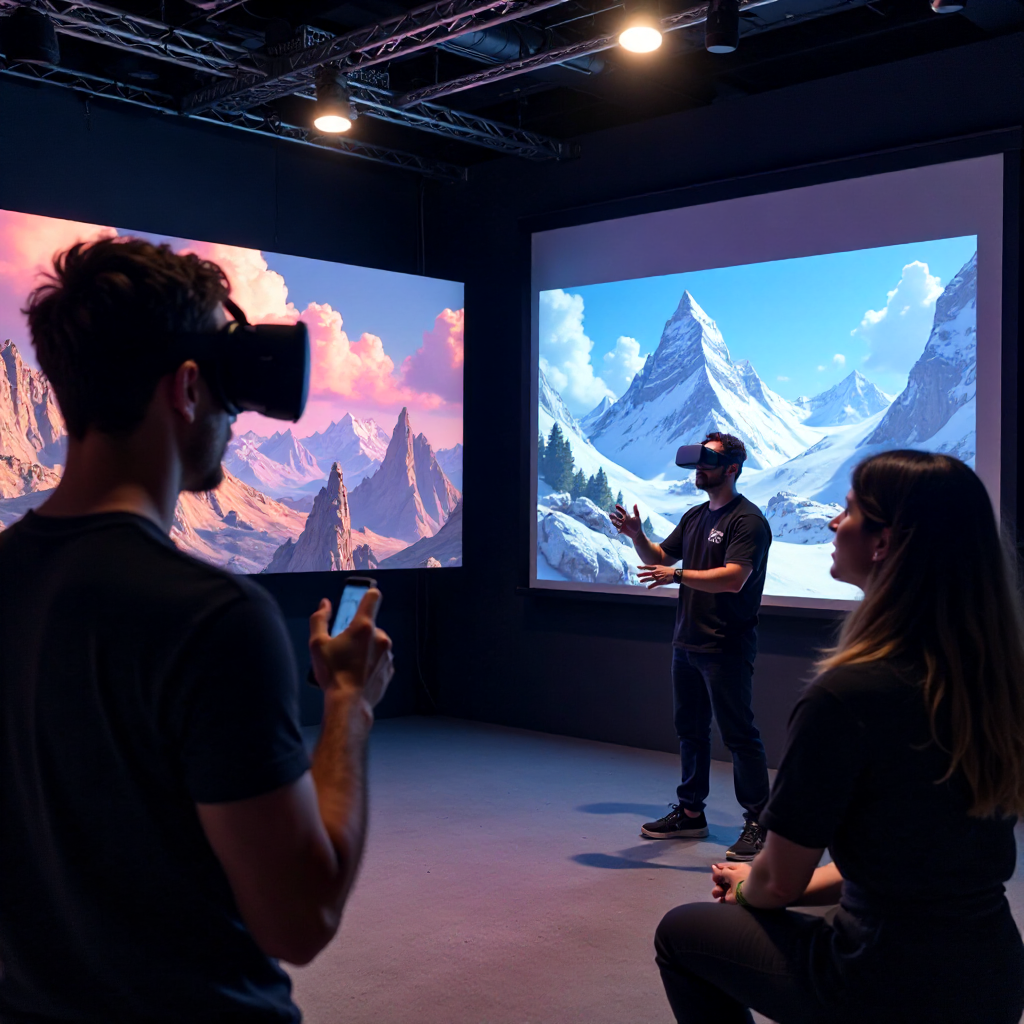
Gaming conventions like Gamescom, PAX, and the now-transformed successor events to E3 remain the highest-impact venues for VR marketing activations. These events concentrate exactly the right audience — enthusiasts, press, and industry professionals — in one physical space.
A well-executed VR booth at a major trade show can generate coverage that outlasts the event by weeks. Attendees share footage, write hands-on previews, and post reactions — turning a physical activation into a distributed content campaign. The live event context also creates natural social proof: a queue forming at a VR station signals to passersby that something worth experiencing is happening.
Logistics matter enormously here. Headset hygiene, session length, queue management, and the ratio of staff to stations all affect how many people actually get through the experience. Studios that understaff their VR activations often find that long wait times frustrate attendees rather than build anticipation.
Smaller conventions and regional gaming festivals offer a different value proposition: lower competition for attention, more time per attendee, and communities that are often more vocal online relative to their size. For mid-tier publishers, these venues can deliver better return than a crowded floor at a major show.
Measuring the Impact: Engagement, Buzz, and Conversion
Assessing VR campaign effectiveness requires looking beyond standard digital metrics. Because many VR activations happen in physical spaces or closed environments, traditional click-through and impression data tells only part of the story.
Studios typically track a combination of signals: social media sentiment and volume in the days following an activation, changes in wishlist numbers on storefronts, press coverage quality and reach, and direct attendee feedback collected on-site. Pre-order velocity following a major convention appearance is one of the cleaner indicators of conversion impact, though isolating VR's contribution from other concurrent marketing activity is genuinely difficult.
One underused metric is content amplification rate — how often attendees create and share their own footage or written reactions. A VR experience that generates organic user content effectively multiplies its reach without additional spend. Studios that build photogenic or shareable moments into the demo design (a dramatic visual reveal, a surprising interaction) tend to see higher organic amplification.
What studios generally find is that VR marketing excels at depth of engagement rather than breadth. Fewer people experience it, but those who do tend to convert at higher rates and advocate more loudly.
Challenges and Limitations of VR as a Marketing Tool
VR marketing carries real constraints that prevent it from scaling the way a video trailer can. Understanding these limits is essential for any studio considering where to invest promotional resources.
Hardware accessibility is the most persistent barrier. A significant portion of the gaming audience doesn't own a VR headset, and asking consumers to experience a marketing campaign through hardware they'd need to borrow or purchase creates obvious friction. Even at events where headsets are provided, the number of people who can physically cycle through a VR station in a day is capped by session length and equipment availability.
Production costs are the second major constraint. Building a polished VR demo — even a short one — requires meaningful development resources. For large publishers, this is a manageable line item. For independent studios, it can represent a disproportionate share of the marketing budget, and the return isn't guaranteed.
There's also the question of audience fit. VR marketing makes intuitive sense for VR-native games, but studios promoting conventional PC or console titles sometimes struggle to justify the investment when the demo experience doesn't directly represent the final product's platform.
Choosing VR marketing for its depth of impact means accepting its limited reach. That trade-off is worth making deliberately, not by default.
The Future of VR in Game Promotion
The next phase of VR game marketing will likely be shaped by three converging developments: social VR platforms, metaverse-adjacent spaces, and AI-assisted demo creation.
Social VR environments — platforms where groups of users share virtual spaces through avatars — are already being used for small-scale game announcements and community events. As headset adoption grows and these platforms mature, they could become viable venues for large-scale promotional launches, combining the intimacy of a VR experience with the reach of a live stream.
The metaverse concept, despite a turbulent few years of hype and skepticism, introduced the idea of persistent branded virtual spaces where players can engage with a game's world between sessions. Some studios are experimenting with pre-launch "world previews" — explorable environments tied to an upcoming title that players can visit and share before the game releases.
AI-enhanced demo generation is perhaps the most practically significant near-term development. If AI tools can reduce the cost and time required to build a polished VR promotional slice, the barrier for smaller studios drops substantially. This could democratize VR marketing in ways that hardware cost reductions alone haven't managed.
VR remains an emerging tactic in game promotion, not a mainstream standard. But the studios experimenting with it now are building institutional knowledge that will compound in value as the technology and its audience both mature.
Frequently Asked Questions
What makes VR marketing more effective than traditional video game trailers?
VR marketing creates first-person presence inside a game world, generating emotional memory that passive video cannot match. Trailers show; VR demos let audiences feel. The trade-off is scale — trailers reach millions, VR activations reach thousands. The two work best in combination.
How do smaller indie studios use VR marketing on a limited budget?
Indie studios typically focus on regional conventions and targeted community events where a smaller activation still reaches a concentrated audience. Some repurpose existing game content into a short demo rather than building a separate VR experience from scratch, which reduces production cost significantly.
What hardware do audiences need to experience VR game marketing campaigns?
At live events, studios provide the headsets — usually standalone devices like the Meta Quest line or tethered PC VR headsets. For home-based VR campaigns distributed through storefronts, audiences need a compatible HMD. This hardware requirement is a genuine accessibility barrier for reaching broader audiences remotely.
How does VR marketing differ from augmented reality marketing for games?
Augmented reality overlays digital content onto the real world through a phone or AR glasses, making it far more accessible — no dedicated headset required. AR campaigns can reach mass audiences through smartphones. VR delivers deeper immersion but requires dedicated hardware and a controlled environment. AR scales; VR immerses. Game studios sometimes use both, with AR for broad reach and VR for high-impact event activations.
Is VR marketing only relevant for VR games, or can it promote non-VR titles too?
VR marketing can promote non-VR games, though the approach changes. Instead of a gameplay demo, studios create atmospheric experiences — walkthroughs of a game's world, character encounters, or lore-based interactive scenes. These work as brand experiences rather than product previews, and they're most effective for titles with strong visual identity or narrative depth.